Desktop Application
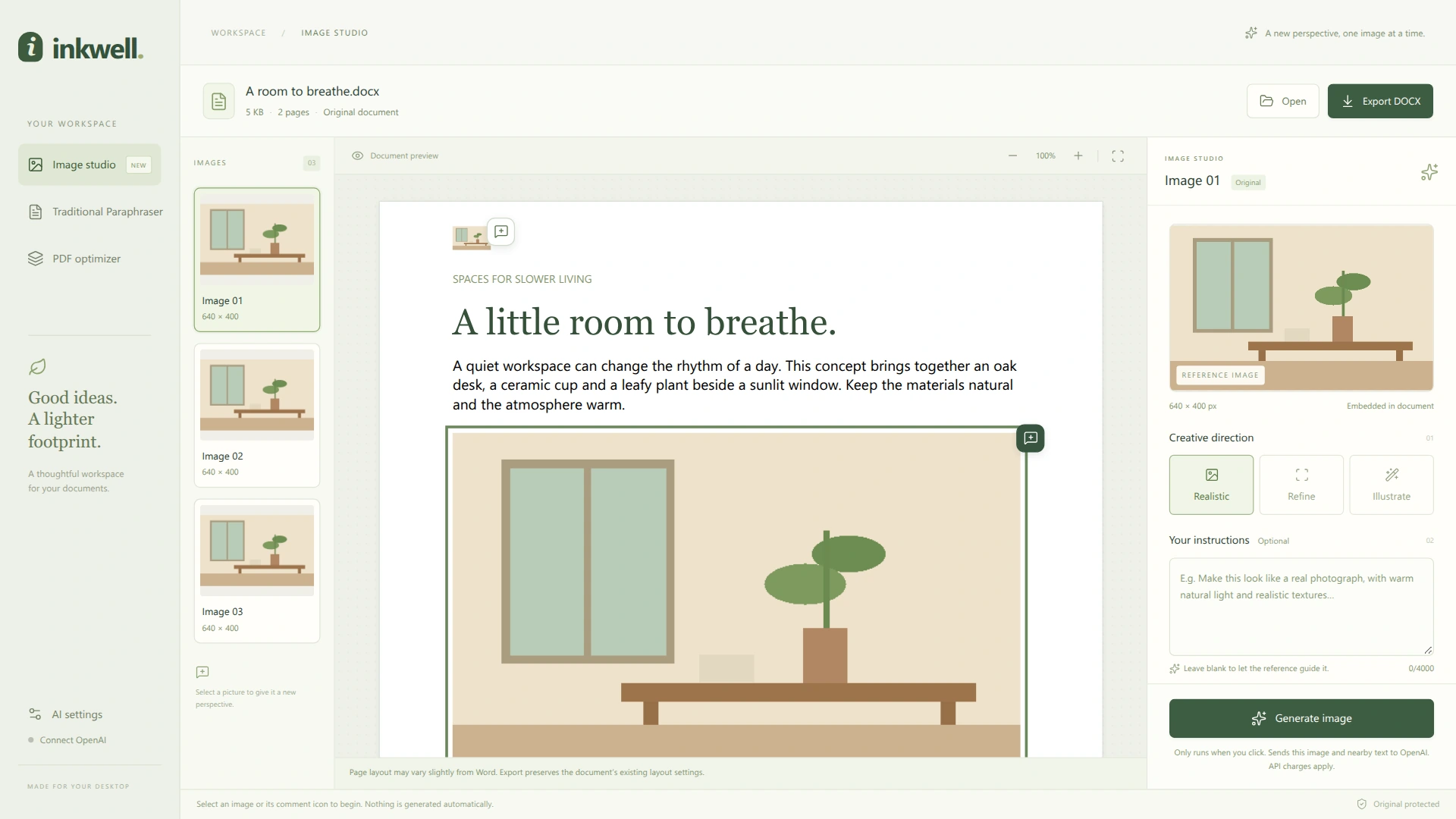
InkWell
InkWell is a Rust and Tauri desktop workspace for reviewing Word drafts offline, editing embedded images, and preparing PDFs for print. I built the Rust commands that export accepted DOCX edits into a new copy and convert PDFs to CMYK with Ghostscript while preserving selectable text and vectors.
How it’s built View architectureHow it’s built
InkWell · Rust and Tauri desktop workspace for offline Word revision, AI image edits and CMYK PDFs
InkWell is a Windows and Linux desktop app for people preparing Word documents and print-ready PDFs. I built it in Rust, Tauri 2 and TypeScript: 12 Tauri commands drive an offline rule-based paraphrase engine across 16 rule modules, a DOCX image studio that sends one selected image to the OpenAI Images Edits API, and a two-pass Ghostscript pipeline that converts PDFs to CMYK with adjustable ink density. Export rewrites only accepted OOXML parts, and 100 Rust tests and 22 Playwright tests cover it.
- Tauri commands
- 12
- offline paraphrase rule modules
- 16
- Rust tests
- 100
- Playwright UI tests
- 22
- lines of Rust
- ~12,800
- GitHub Actions workflows
- 3
Technology and what it does here
- Rust
- All document processing, validation and API calls run in the native backend
- Tauri 2
- Desktop shell exposing 12 IPC commands plus native file dialogs
- Ghostscript
- Pdfwrite CMYK conversion with transfer-function ink density, bundled in Windows installer
- lopdf
- Validates PDF structure and checks page count is preserved after conversion
- zip + roxmltree
- Read and rewrite DOCX OOXML parts while raw-copying unchanged members
- reqwest
- Multipart calls to OpenAI Images Edits from Rust, never from the frontend
- image crate
- Decodes PNG, JPEG and WebP embedded images and enforces size limits
- spaCy (optional)
- Local Python clause-boundary parsing that guides structural sentence rewrites
- TypeScript + Vite
- Paraphrase, image studio and PDF optimizer interfaces
- docx-preview
- Renders Word pages in an isolated shadow root with local pagination
- Playwright
- Headless UI tests with mocked native IPC and OpenAI responses
- GitHub Actions
- Windows installer builds, upgrade test and private-key edition build
Implementation details
- PDF conversion runs Ghostscript twice: a first pass strips document transfer functions, the second applies the chosen density as t(x)=1-d+d*x, then lopdf verifies the page count before an atomic save.
- DOCX handling enforces limits of 80 MB archive, 256 MB expanded and 12 MB per XML part to reject zip bombs before parsing.
- The spaCy mode is optional: the Rust side locates a Python interpreter (INKWELL_SPACY_PYTHON or python3/python) and falls back to built-in rules when it is missing or its draft fails validation.
- A private two-person edition compiles an OpenAI key in through the opt-in Cargo feature private-key from a CI secret, and the workflow refuses to run in a public repo.
System architecture
InkWell uses a TypeScript interface and Rust commands in Tauri for offline Word review, image editing, and CMYK PDF conversion.
Technologies
- Tauri
- Rust
- TypeScript
- Ghostscript
- OOXML